1. Lead market snapshot
According to the LBMA, the London gold benchmark, or LBMA Gold Price PM, stood at US$4,496.70 per ounce on May 19, 2026. On the same day, LBMA also recorded a silver benchmark of US$76.040. These levels offer a clear starting point for reading the bullion market today: precious metal prices remain historically high, but the short-term direction is not moving in a straight line.
2. Price context and spread
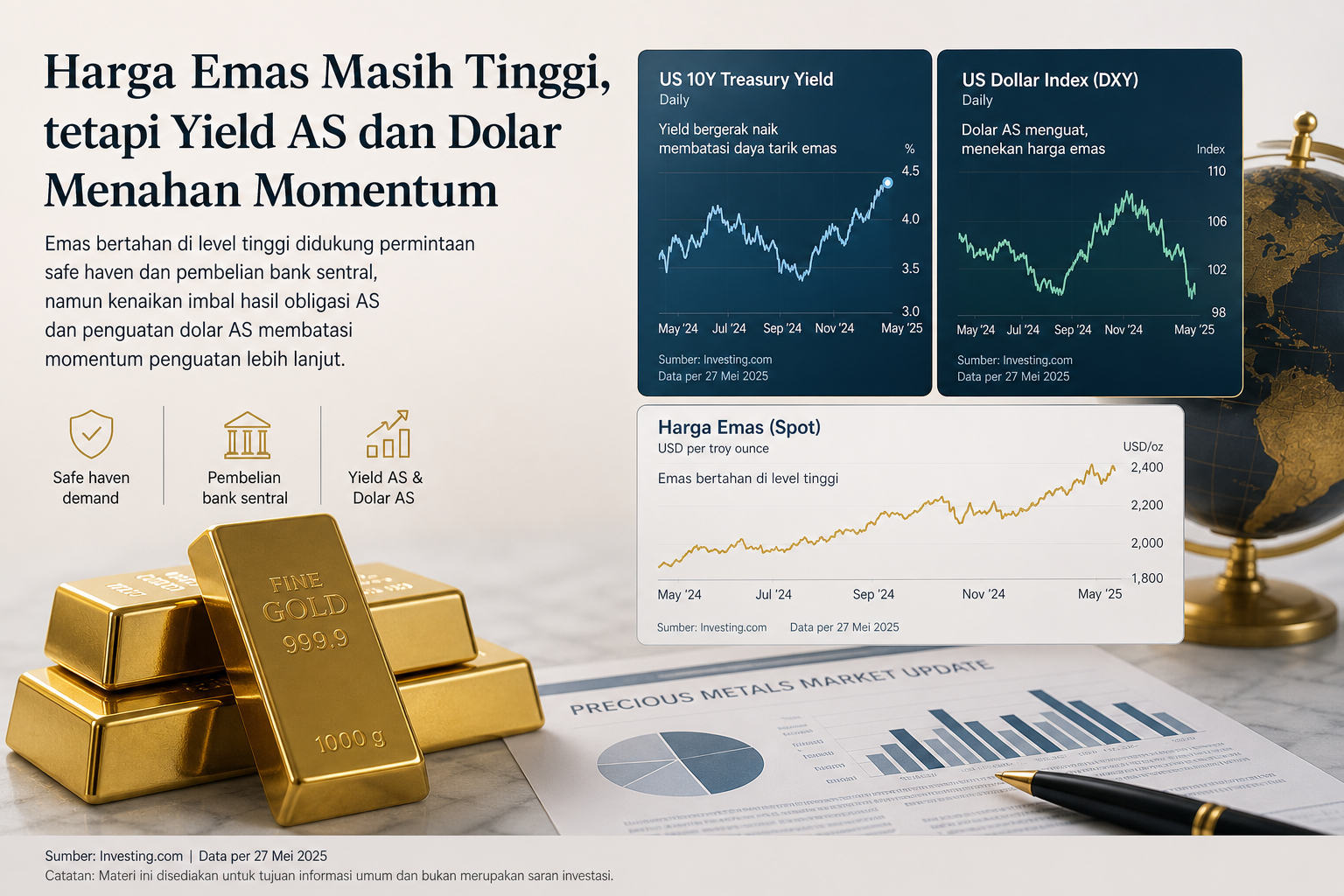
The market therefore looks firm, but not free of pressure. On one side, gold continues to attract attention as a hedge when geopolitical risk, energy inflation, and broader macro uncertainty remain in focus. On the other, higher U.S. Treasury yields and a stronger U.S. dollar can slow further gains, because both affect the relative appeal of gold, which does not pay interest.
For bullion readers, that context matters because high prices can make the market story sound simple: gold rises when risk increases. In practice, the latest data points to a more balanced picture. Safe-haven demand remains relevant, but price momentum can soften when yields rise and the dollar becomes an alternative refuge.
3. Main movers or strongest signal
The benchmark remains high, but the range has become more sensitive
The LBMA level of US$4,496.70 per ounce shows gold is still trading at an elevated global benchmark. Silver is also at a notable level at US$76.040 per ounce. Even so, benchmark data like this should be read as an international reference, not as a local retail price or a physical transaction price in every country.
In the bullion market, the gap between global benchmarks and retail prices can be shaped by operational factors, including production costs, distribution, taxes, stock availability, and product premiums. Because the data used here comes from external sources such as LBMA, FRED, and Kitco, this article does not rely on internal price lists, ERP snapshots, or private feeds.
Higher benchmarks can also make the market more sensitive to new headlines. When prices are already elevated, profit taking can appear more quickly after macro releases or geopolitical developments. That does not mean the longer-term trend has already turned, but it does suggest daily moves can become sharper than in calmer periods.
LBMA Alchemist’s Forecast Survey 2026 says precious metals entered 2026 with strong tailwinds, but also with rising risks. The survey points to potential volatility in gold, silver, platinum, and palladium, supported by expectations for lower U.S. real rates, possible Federal Reserve easing, central bank diversification away from the dollar, and geopolitical tension. The same source also notes that volatility risk and weaker jewelry demand could make price corrections sharper.
In other words, high prices are not only a sign of strength. They also make the market more reactive to changes in expectations. When physical buyers face much higher prices, some demand can be delayed. At the same time, market participants who have already benefited from earlier gains may choose to reduce exposure, especially if macro indicators argue for caution.
U.S. yields and the dollar are the main drag
FRED, the Federal Reserve Bank of St. Louis data service, showed the 10-year U.S. Treasury yield at 4.57% on May 21, 2026, with the data updated on May 22, 2026. That level matters for gold because gold does not pay a coupon. When U.S. government bond yields stay high, the opportunity cost of holding gold rises as well.
The mechanism is straightforward. If investors can earn a return from bonds, gold must compete with assets that provide regular income. In that setting, gold can still be supported as a hedge, but its upside can be capped because some market participants see interest-bearing assets as more attractive from a cash-flow perspective.
Pressure from yields often moves together with the U.S. dollar. Kitco reported that spot gold and silver fell sharply after Tuesday’s close, with the main factors being higher Treasury yields, a stronger U.S. dollar, and inflation concerns linked to oil. The report also noted that this pressure can offset safe-haven demand tied to risks around the Strait of Hormuz.
A stronger dollar has its own effect on precious metals. Because gold and silver are generally priced in U.S. dollars globally, a firmer dollar can make these metals more expensive for buyers using other currencies. That can weigh on near-term demand, especially when benchmark prices are already high.
Even so, the link between yields, the dollar, and gold is not always simple. High yields can pressure gold if the market reads them as higher real returns. But high yields can also appear alongside fiscal or inflation concerns, which in some cases supports demand for hedges. For that reason, gold’s reaction to yields should be read together with the broader macro backdrop, not from a single number alone.
Safe-haven demand remains, but it is competing with the dollar
Geopolitical risk remains an important part of the bullion narrative. In March 2026, Kitco quoted Natixis analyst Bernard Dahdah as saying conflict involving Iran could offer safe-haven support for gold. The same article also stressed that uncertainty can support the U.S. dollar as a safe haven, meaning gold is not always the only destination for defensive flows.
That note is useful for reading the market now. When geopolitical risk rises, some investors look for assets they consider safer. Gold is usually on that list, but the U.S. dollar often attracts similar flows. If the dollar strengthens at the same time, the safe-haven support for gold can become more limited.
Kitco also said gold previously failed to hold above US$5,100 per ounce in the context of Iran-related war risk and the inflation impact of possible energy price increases. That example shows that elevated price levels can be difficult to sustain when the market faces a mix of profit taking, a stronger dollar, and shifting inflation expectations.
Energy inflation is one factor to watch because it can push in both directions. If energy prices rise sharply, markets may see a higher inflation risk and look for hedges. But if inflation worries push yields higher or strengthen the dollar, gold can also come under pressure. That is why a safe-haven story does not automatically mean gold will rise without resistance.
Silver also sends a mixed signal. LBMA said the 2026 silver market is expected to remain tight, supported by a structural deficit, limited mine supply, and demand from electrification, electronics, and AI. But LBMA also warned the market is already stretched and vulnerable to lower premiums, substitution, recycling, and profit taking.
Silver often has two identities: precious metal and industrial metal. When industrial demand is strong, silver can gain extra support. But when prices become too high or industrial activity slows, buyers may seek substitutes, delay purchases, or increase use of secondary supply. That is why silver can move more sharply than gold in a sensitive market phase.
4. Editorial takeaway
For the bullion market overall, the strongest signal right now is the tug of war between still-elevated benchmarks and near-term macro pressure. LBMA suggests precious metals have structural tailwinds, while FRED and Kitco show that U.S. yields and the dollar can be a real restraint. That combination keeps the tone cautious, even though interest in safe-haven assets has not disappeared.
The editorial conclusion is simple: gold is still trading at high levels, but the market is not free from correction risk. As long as U.S. Treasury yields stay elevated and the dollar remains firm, gold momentum can stay capped even if geopolitical risk and inflation still give some market participants reasons to watch bullion closely. Readers should view benchmark data, public sources, and macro changes together, rather than following a single price narrative.
5. Reference reminder
This article uses public references from LBMA, FRED (Federal Reserve Bank of St. Louis), and Kitco. The quoted prices, yields, and dates come from those sources. This commentary is editorial market coverage and is not intended as investment advice, a recommendation to buy, or an instruction to sell any specific precious-metal product.
References
- LBMA (2026). LBMA mencatat harga acuan emas London sekitar USD 4.496,70/oz pada 19 Mei 2026. Bullish secara struktural karena harga benchmark masih berada di level tinggi; relevan untuk membandingkan pergerakan harga retail domestik terhadap acuan internasional.
- LBMA (2026). LBMA Forecast Survey 2026: analis melihat logam mulia tetap volatil dengan tailwind kuat. Bullish secara struktural, tetapi volatilitas tinggi dan demand jewellery yang melemah dapat membuat koreksi harga lebih tajam.
- FRED, Federal Reserve Bank of St. Louis (2026). Yield Treasury AS 10 tahun bertahan di 4,57% per 21 Mei 2026. Bearish jangka pendek untuk emas jika yield riil ikut naik; namun dapat menjadi bullish jika yield tinggi mencerminkan kekhawatiran fiskal atau inflasi yang mendorong permintaan lindung nilai.
- Kitco (2026). Kitco: Spot emas turun tajam setelah yield Treasury dan USD menguat. Mixed-to-bearish jangka pendek: safe-haven demand ada, tetapi kalah oleh tekanan yield dan USD yang lebih kuat.
- Kitco (2026). Kitco: Risiko perang Iran dapat menopang emas, tetapi USD juga menjadi safe haven. Bullish jika konflik berkepanjangan dan harga energi memicu inflasi; tetapi USD yang kuat dan profit taking dapat menahan kenaikan emas.
- LBMA (2026). LBMA: pasar silver 2026 diperkirakan ketat, tetapi rawan koreksi karena harga tinggi. Bullish untuk silver dan produk bullion berbasis perak selama tightness berlanjut; namun risiko koreksi besar meningkat jika demand industri melemah atau suplai sekunder naik.