According to Indonesia’s Statistics Agency (BPS), the country’s non-oil and gas trade surplus in early 2026 was still largely supported by key commodities. In its release on May 6, 2026, BPS recorded cumulative exports for January–March 2026 at US$66.85 billion, up 0.34% from the same period a year earlier. The surplus contributors cited by BPS included animal or vegetable fats and oils at US$8.68 billion, mineral fuels at US$6.22 billion, iron and steel at US$4.29 billion, and nickel and its products at US$3.24 billion.
That data provides important context for the theme of “rising commodity prices” in Indonesia. For CPO, coal, and nickel, the impact does not stop at producers. Export flows, state revenue, the trade balance, rupiah stability, and purchasing power in some producing regions can all be affected.
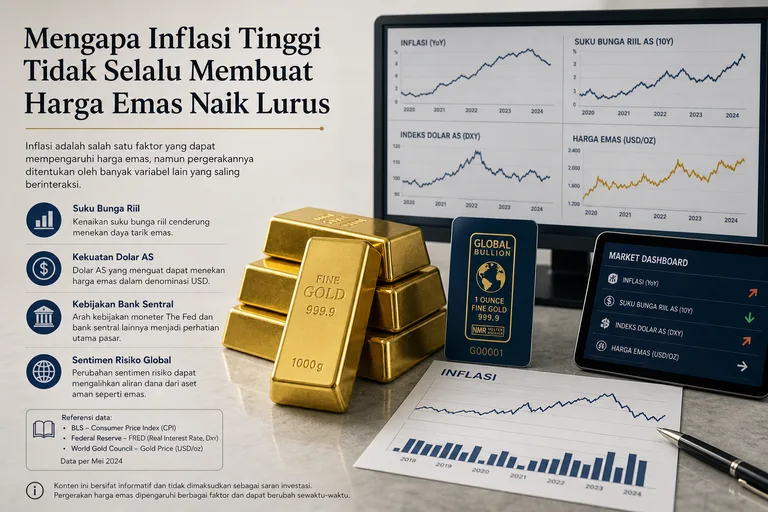
For bullion readers, the connection is also relevant. Gold in the domestic market does not move only on global prices; it is also influenced by the rupiah against the US dollar, inflation expectations, interest rates, and demand for safe-haven assets. So when commodities strengthen, gold readers need to look at two sides at once: support for the domestic economy and risk from global volatility.
Lead market snapshot: commodities are helping the external buffer
Export commodities act as one source of foreign exchange. When commodity export values are strong, Indonesia may gain a better external buffer through a trade surplus. In BPS data, the groups of vegetable oils and fats, mineral fuels, iron and steel, and nickel remain important contributors to the non-oil and gas surplus.
In simpler terms, commodity exports can help foreign currency flow into the country. That flow can be one factor supporting rupiah stability, though it is certainly not the only one. The exchange rate is still shaped by many other variables, including interest rates, global sentiment, energy prices, and the direction of the US dollar.
Bank Indonesia has signaled that pressure on the rupiah remains a key concern. On May 20, 2026, BI raised the BI-Rate by 50 basis points to 5.25%, with the Deposit Facility at 4.25% and the Lending Facility at 6.00%. BI said the move was aimed at strengthening rupiah stability amid global volatility and keeping inflation within the 2.5% ± 1% target in 2026–2027.
BI also noted that on May 19, 2026, the rupiah stood at Rp17,700 per US dollar, weakening 2.20% from the end of April. This matters because it shows that a commodity surplus does not automatically shield the rupiah from pressure. Export support can help, but global stress can still dominate at times.
Price context and spread: who may benefit
The first group that usually feels the most direct benefit is commodity exporters. When CPO, coal, nickel, and related product prices or export values rise, revenues in US dollars can also increase. In BPS’s framing, the categories of animal and vegetable fats and oils, mineral fuels, iron and steel, and nickel remain pillars of the non-oil and gas surplus.
For businesses with export access, this can improve cash flow and strengthen operating capacity. But the benefit still depends on production costs, sales volume, export contracts, government policy, and demand conditions in destination markets. Higher commodity prices do not always mean margins rise by the same amount.
The second beneficiary is the state, through potential revenue and resource control. Reuters, via Investing.com, reported that President Prabowo Subianto said the government would centralize exports of key commodities to increase state revenue and strengthen control over natural resources. The commodities mentioned included palm oil, coal, ferroalloys, and potential price-setting for nickel and gold.
This kind of policy is worth monitoring because it may affect how commodities are traded, how foreign exchange is managed, and how state revenue is collected. For markets, the impact cannot be concluded before implementation details are available. Still, the direction of policy suggests that strategic commodities are increasingly being positioned as national economic instruments, not just ordinary export products.
The third beneficiary is the trade balance. When non-oil and gas exports are strong, the trade surplus can become an important support for the economy. BPS data shows that Indonesia’s non-oil and gas surplus still has several major pillars, including vegetable oils, mineral fuels, steel, and nickel.
For financial markets, a healthier trade balance is often read as a positive signal for external resilience. If exports help foreign exchange supply, the rupiah may receive support. Even so, the effect still needs to be read alongside import demand, external debt payments, capital flows, and the global strength of the US dollar.
The fourth beneficiary is some producing regions. Areas linked to palm oil plantations, coal mining, or the nickel industrial chain may experience more active economic turnover when commodity activity rises. The effect can come through logistics demand, support services, labor, and local trade activity.
However, regional benefits are not always evenly distributed. Some areas are closer to production centers and export infrastructure, while others receive only indirect effects. For that reason, reading commodities from a regional economic angle still requires caution and should not be generalized.
Main mover or strongest signal: nickel and supply control
Among the latest available signals, nickel offers a fairly clear example of how Indonesia’s supply can influence global prices. Trading Economics reported that nickel futures moved back above US$18,800 per ton after hitting a near four-week low. The move was linked to reports of additional output cuts in Indonesia.
In the same report, Indonesia was said to have reduced this year’s nickel ore mining quota to support prices. The step triggered raw material shortages and output cuts at local smelters. This shows that Indonesia’s supply policy can be an important factor for the global nickel market.
For bullion readers, nickel is not gold. But nickel’s signal helps read the broader commodity mood. When industrial commodities move on supply, policy, and demand, markets can become more sensitive to inflation risk and supply-chain disruption.
Higher prices for industrial commodities and energy can also create layered effects. On one hand, exporting countries may earn more. On the other, input and energy costs can pressure sectors that rely on raw materials or fuel. That is why commodities often bring mixed effects to an economy.
Editorial takeaway: the risks behind commodity optimism
The first risk is inflation. BPS reported April 2026 inflation at 0.13% month on month. That number itself looks contained, but the market still needs to watch energy prices, logistics costs, and food prices if commodity volatility continues.
Bank Indonesia also reiterated its focus on rupiah stability and the inflation target. The increase in the BI-Rate to 5.25% signals that the central bank sees a need for policy response amid global volatility. For households and businesses, higher interest rates can affect financing costs and spending decisions.
The second risk is a strong US dollar. Kitco News reported that gold and silver were supported by safe-haven demand amid the Iran war and rising risk aversion. In the same report, Kitco also highlighted a firmer US dollar, higher oil prices, and market attention on inflation and the Federal Reserve’s stance.
This combination matters. A stronger US dollar can pressure emerging-market currencies, including the rupiah, while higher oil prices can add to inflation concerns. At the same time, geopolitical tensions can increase demand for gold as a safe-haven asset.
The third risk is export policy. Reuters reported a plan to centralize exports of key commodities, with the aim of increasing state revenue and strengthening control over natural resources. If this policy covers commodities that are sensitive to the domestic market, investors need to watch its effect on goods flows, foreign exchange flows, and price formation.
For gold, an extra point of attention comes from Reuters’ report that also mentioned potential price-setting for nickel and gold. There is not yet enough policy detail to draw a firm conclusion about the impact. Still, the local bullion market needs to follow this development factually, especially if new rules later affect supply, domestic pricing, or trade flows.
Reference reminder: implications for domestic gold and bullion
The relationship between commodities and gold is not one-way. If a commodity surplus helps the rupiah stay more stable, the rise in gold prices in rupiah terms may be more restrained than during a sharp currency slump. Conversely, if global volatility strengthens the US dollar and puts pressure on the rupiah, local gold prices can rise even if global gold prices do not move by as much.
On interest rates, the BI-Rate increase can raise the opportunity cost of holding gold because interest-bearing assets become relatively more attractive. Still, gold often remains in focus when geopolitical risk, inflation, and currency weakness rise. For that reason, readers should avoid looking at just one indicator.
As a retail bullion price context, official data available for May 23, 2026, showed that several products recorded lower daily selling prices. Based on the Antam website, Antam Normal 100 gram gold was listed with a buy price of Rp257,700,000 and a sell price of Rp271,660,000, down Rp1,500,000 from the previous selling price. The spread between the buy and sell prices for that size was Rp13,960,000.
Based on the Hartadinata website, the Hartadinata Gift Series 100 gram product was listed with a buy price of Rp253,400,000 and a sell price of Rp262,900,000, down Rp1,200,000 from the previous selling price. The spread was Rp9,500,000. Meanwhile, based on the Silvergram website, the Silvergram Normal 250 gram product was listed with a buy price of Rp14,080,000 and a sell price of Rp16,001,000, down Rp274,000 from the previous selling price, with a spread of Rp1,921,000.
These price notes do not change the article’s main point: the local bullion market needs to be read together with global and domestic factors. A daily price decline in certain products does not automatically cancel the inflation or safe-haven narrative. Likewise, stronger commodities do not automatically mean gold always rises.
Kitco News, citing Reuters, also reported that Deutsche Bank raised its 2026 gold price forecast to US$4,450 per ounce from US$4,000 per ounce. The reasons cited included stabilizing investment flows and persistent central bank demand. At the same time, the report noted the risk that Federal Reserve rate cuts could be smaller than expected.
This should be read as a market reference, not a certainty about price direction. Forecasts from financial institutions can change when inflation data, central bank policy, or geopolitical conditions change. For retail readers, the key is understanding the drivers rather than treating a forecast number as the only benchmark.
Editorial reading for Indonesia
If CPO, coal, and nickel strengthen, the most clearly positioned beneficiaries are exporters, commodity supply chains, the state through revenue, the trade balance, and some producing regions. That logic makes sense because these commodities are directly tied to exports and foreign exchange flows.
But commodity gains do not come without costs. Higher energy prices, a strong US dollar, inflation pressure, interest-rate changes, and export policy can make the outcome mixed. That is why a too-simple reading — for example, “commodities are up, so everyone wins” — is not sufficient.
For gold readers, the main lesson is to view commodities as part of the macro map. A commodity surplus can help the rupiah, and a more stable rupiah can limit some of the pressure on local gold prices. But if global volatility rises, the US dollar strengthens, or inflation becomes a renewed concern, gold can still find support from safe-haven demand.
In other words, stronger commodities are important news for Indonesia, but they are not a single signal for bullion decisions. Readers should monitor official BPS data, Bank Indonesia policy, export policy developments reported by Reuters, and global gold dynamics from sources such as Kitco. A calm, data-based approach is more useful than reading every price move as a major signal.
As a reminder, this article is educational and editorial. The data used refers to BPS, Bank Indonesia, Reuters via Investing.com, Trading Economics, Kitco News, and the official product price websites cited above. This information is not personal investment advice, but a framework for understanding how commodities, the rupiah, inflation, and bullion are connected.
References
- Bank Indonesia (2026). BI menaikkan BI-Rate 50 bps ke 5,25% untuk stabilisasi rupiah. Kenaikan suku bunga domestik dapat menaikkan opportunity cost memegang emas dalam rupiah, tetapi pelemahan rupiah terhadap USD biasanya menaikkan harga emas lokal dan memperkuat narasi lindung nilai.
- Badan Pusat Statistik (2026). BPS: surplus nonmigas Indonesia ditopang minyak nabati, bahan bakar mineral, baja, dan nikel. Surplus komoditas dapat membantu bantalan eksternal Indonesia dan rupiah; rupiah yang lebih stabil dapat menahan kenaikan emas lokal, tetapi pendapatan komoditas yang lebih kuat dapat mendukung daya beli investor domestik.
- Investing.com / Reuters (2026). Indonesia menyiapkan sentralisasi ekspor komoditas kunci. Jika kebijakan ekspor memasukkan emas atau memengaruhi arus valas komoditas, pasar bullion lokal perlu memantau implikasinya terhadap pasokan, harga domestik, dan stabilitas rupiah.
- Kitco News (2026). Kitco: emas dan perak mendapat dukungan safe-haven di tengah perang Iran. Menguatkan angle bahwa lonjakan komoditas energi/geopolitik dapat memicu inflasi dan risk aversion, dua faktor yang sering mendukung emas meski USD kuat bisa menjadi penahan.
- Kitco News / Reuters (2025). Deutsche Bank menaikkan proyeksi emas 2026 menjadi US$4.450/oz. Memberi konteks bullish struktural untuk emas: permintaan bank sentral dan investor dapat tetap menopang harga meski kebijakan suku bunga global menjadi sumber volatilitas.
- Trading Economics (2026). Nickel rebound karena pemangkasan output Indonesia. Kenaikan nikel mendukung narasi broad commodity upcycle; jika mendorong surplus ekspor, dampaknya dapat menguatkan rupiah, tetapi volatilitas komoditas juga bisa meningkatkan minat pada emas sebagai diversifier.