An emergency fund is, at its core, money set aside for days that do not go according to plan. That is why the main question is not only “which option gives the better return,” but “how quickly must this money be available when trouble comes.” From a personal finance perspective, liquidity, or how easily an asset can be turned into spendable money, is often more important than the potential for its value to rise.
Many people are interested in keeping part of their emergency fund in physical gold because gold feels tangible, easy to understand, and less flexible than cash for everyday spending. There is an upside to that: gold can help curb the habit of dipping into reserves for needs that are not truly urgent. But physical gold is not a full replacement for cash savings, especially when a need appears suddenly and must be paid for right away.
Imagine a simple situation. Your motorbike breaks down just as you need to leave for work, your child needs to see a doctor at night, or a family member needs immediate help. In conditions like these, an emergency fund should be easy to use without haggling, without searching for a gold shop that is still open, and without waiting for the price to feel right before selling.
On the other hand, not every emergency requires money within minutes. Some needs still allow a bit of time, such as covering living expenses when income drops, preparing to move to a new rental place, or keeping a buffer while looking for a new job. For needs like these, part of the reserve can be held in a more flexible range of forms, including physical gold, as long as the cash portion remains secure.
Needs that must be paid for the same day
The front line of an emergency fund should remain in cash or cash equivalents. In practice, that means money that can be accessed quickly through a bank account, a digital wallet you actually use, or a reasonable amount of cash kept safely. The goal is not to chase returns, but to make sure a problem does not become bigger simply because the money is hard to access.
Cash has the advantage because it can be used immediately to pay for small but important things. Medicine, sudden transportation costs, minor repairs, or household needs that cannot be postponed usually do not wait for the best time to sell an asset. If your entire emergency fund is stored in physical gold, you still have to convert that gold into money first.
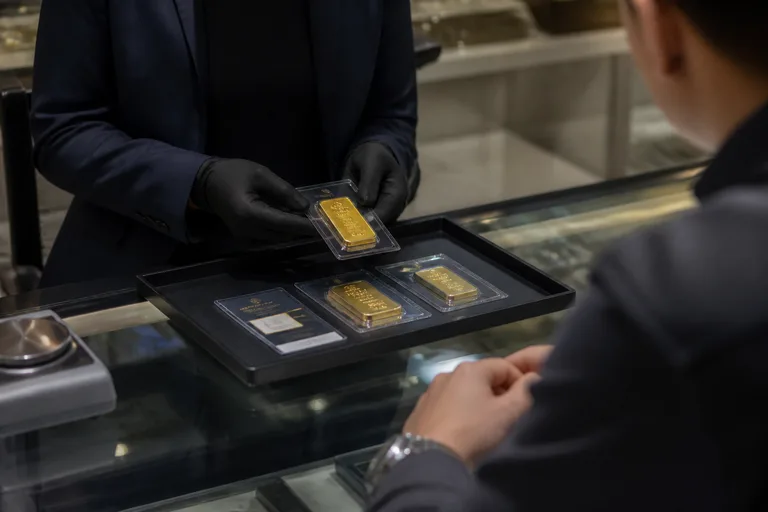
Selling physical gold can indeed be quick if access is easy. But there are still extra steps: bringing the gold, making sure the shop or buyback location is open, checking the price, and then receiving the money. In a big city, this process may feel simple, but in a panic, when you are sick, during heavy rain, or on a public holiday, those extra steps can become a burden.
For readers living in Bali, location also needs to be considered in practical terms. Access to banks, ATMs, gold shops, or places to buy and sell gold may feel easy in busy areas, but it is not always the same if you are far from the city center, working irregular hours, or living in an area where activity depends heavily on the tourism season. A good emergency fund should fit the rhythm of everyday life, not just look good on paper.
Cash is also useful when the person receiving the payment does not want, or cannot accept, another form of payment. A small repair shop, a food stall, a transport service, or help for family may require money on the spot. In that kind of situation, physical gold does not solve the problem until it has been converted into rupiah.
That is why the first portion of an emergency fund is best viewed as a “fire extinguisher.” It does not need to grow quickly, it does not need to look like the smartest investment choice, and it does not need to be complicated. What matters is that when something unpleasant happens, the money can be used without adding more panic.
Problems arise when someone focuses too much on the sense of security that comes from owning gold, but forgets the main function of an emergency fund. Gold can feel safe because it is tangible and its value is widely recognized. But if an emergency comes at night or when the buying and selling market is not ideal, that sense of security can turn into inconvenience.
Cash also helps keep decisions rational. When ready-to-use money is available, you are not forced to sell a valuable item in a rush. Financial decisions made under pressure are often less favorable, not because the asset itself is bad, but because the timing leaves little room to think.
Physical gold for reserves that are not urgent
Physical gold starts to make sense once an emergency fund already has enough cash for urgent needs. In this position, gold is not the first door to open, but the next layer of reserves. Its role is better suited to needs that can still be planned over several days, not expenses that must be settled by this afternoon.
There are several reasons people choose physical gold for part of their reserves. Gold is not as easy as money in a bank account to spend impulsively. Its form is also simple: you buy it, store it, then sell it when needed. For some people, the small barrier to liquidating gold actually helps keep the fund from leaking into expenses that are not priorities.
However, that barrier should be understood as a consequence. Physical gold has a buying price and a selling price, and they are not always the same. When buying, you pay a certain price; when selling, the price you receive may be lower than the price displayed for a new purchase. This spread makes gold less suitable for funds that may need to be used in the very near term.
Another risk is having to sell when the price is not ideal. Under normal circumstances, someone can wait for a more comfortable time to sell gold. In an emergency, that option becomes narrower. If you have to sell because you need money quickly, you may have to accept the price available at that moment, not the price you hoped for.
This does not mean physical gold is bad. What should be avoided is treating gold like a daily transaction account. Gold is better suited as a store of value for the part of your reserves that is not touched often, not as a place to keep all the money you may need at any time.
Before adding physical gold to an emergency fund, first look at your own risk profile. Someone with a steady income, strong family support, and stable monthly expenses may have more room to place part of their reserves in gold. By contrast, freelancers, small business owners, or people with seasonal income usually need a thicker cash portion because their cash flow can change more easily.
For workers in tourism, food businesses, transportation, or daily services, an emergency fund is often not only for major events. Sometimes its role is to cover gaps in income, replace work equipment, or patch small operating costs that appear suddenly. If income does not always arrive regularly, keeping too much of an emergency fund in gold can make cash flow feel rigid.
Family circumstances also matter. If you support parents, children, a spouse, or other family members, emergencies can come from more directions. In that situation, liquidity becomes even more important. Physical gold may be part of the plan, but it should not reduce your cash readiness for household needs.
There is also the matter of storage. Physical gold needs a safe place, well-kept proof of purchase, and the habit of maintaining privacy. If it is stored carelessly, the risk is not only about price but also about loss. An emergency fund should reduce mental burden, not create new anxiety because you are worried the item might go missing.
The size of the gold pieces also needs thought. Pieces that are too large can make things difficult if the amount of money needed is smaller than the value of the gold being sold. You may be forced to liquidate more than necessary. Smaller pieces are usually more flexible, although this decision still needs to be adjusted to costs, storage, and the main purpose of the fund.
A healthier approach is to imagine an emergency fund as several layers. The front layer is money that can be accessed immediately. The next layer is other cash savings that are not used daily but are still easy to move. Only after that should physical gold be considered for the portion that is touched less often.
This kind of allocation gives each form of money a clear job. Cash is there to handle sudden events. Physical gold is there to keep part of the reserve from being spent too easily while still holding value over a longer period. The two do not need to be seen as opposing choices, as long as the order is right.
A common mistake is starting with the question “how much gold should I own,” when the first question should be “how much money must be ready to use without selling anything.” Once that immediate need is covered, then it makes sense to move on to the question of physical gold. This order matters because an emergency fund is not your main investment portfolio.
If your emergency fund is still small, the priority is to build up cash first. There is no need to rush into buying gold just because you are afraid cash will lose value. When funds are still limited, flexibility matters more than long-term value protection.
If your cash reserve already feels sufficient to handle everyday disruptions, then physical gold can be used as a complement. Start with a portion that will not make you panic if it cannot be liquidated on the same day. Think of gold as the reserve to touch last, not the first source of money when a problem appears.
This decision should also be reviewed when life changes. Getting married, having children, changing jobs, starting a business, or caring for family can change liquidity needs. An emergency fund that used to be enough may need to be reorganized, including whether the gold portion still fits or should be reduced for a while.
In the end, a good emergency fund is not the one that looks the most sophisticated, but the one that truly helps when life is difficult. Cash provides speed and peace of mind for sudden needs. Physical gold can be a complement for reserves with a longer time horizon, as long as you understand that liquidating it requires time, a place to sell, and a price that may not match your expectations.
So, keep emergency funds in physical gold only after urgent needs are already covered by cash. If they are not, do not feel left behind. In an emergency, money that can be used now is often far more valuable than an asset that looks safe but may not be liquidated in time.