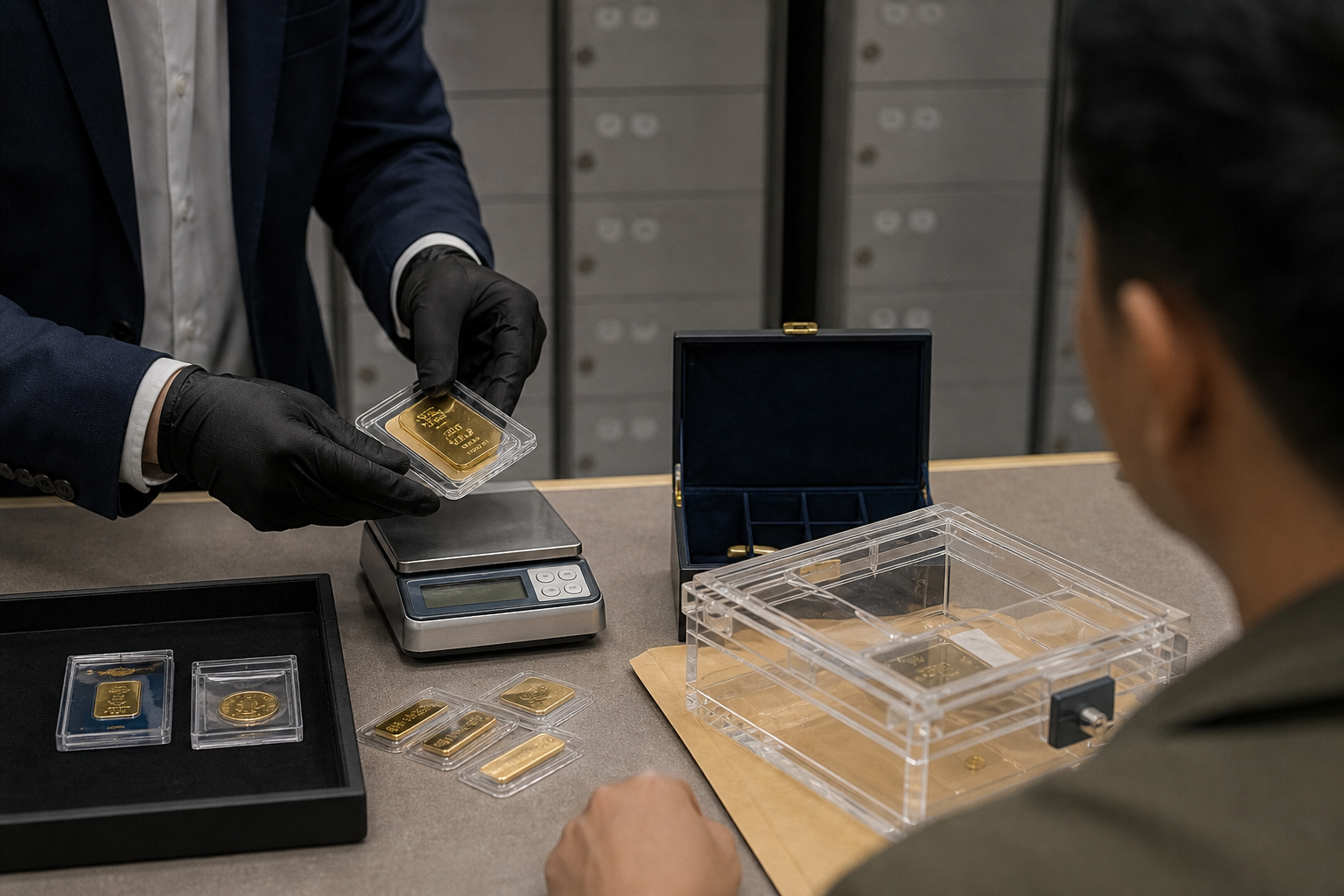
Storing physical gold seems simple until you actually own it. As long as it is just one small piece, slipping it into a drawer or cupboard may feel sufficient. But once its value starts to matter to your household finances, how you store gold becomes an important decision involving security, access, cost, and peace of mind.
There is no single choice that is always right for everyone. Some gold owners feel more comfortable keeping it at home because they can access it at any time. Others prefer a safe deposit box because they feel safer leaving the asset in a dedicated facility.
What you should avoid is choosing simply because you are following what other people do. Physical gold is different from a digital balance or a bank deposit. It is small, holds concentrated value, is easy to move, and if it goes missing, proving ownership can be complicated. That is why the decision about where to store it should be made consciously, not merely by looking for a place that feels “hidden.”
When gold is stored at home
The clearest advantage of storing gold at home is access. You can check it, move it, or use it at any time without depending on the operating hours of a storage provider. For some people, this gives a strong sense of control, especially if the gold is intended as an emergency reserve.
But easy access also means the responsibility rests entirely with the owner. If the home is affected by theft, fire, flooding, or other damage, that risk does not automatically shift to someone else. For that reason, storing gold at home is not simply a matter of finding a place that is rarely seen.
Places such as clothing drawers, under the mattress, kitchen cabinets, or jewelry boxes often feel safe because they are familiar to the homeowner. The problem is that these are also among the most predictable places to look. If you choose home storage, think through the worst-case scenarios: would the gold still be protected if a stranger entered the house, if panic set in, or if you were not at home?
A safe can be an option, but its quality and installation matter. A small, lightweight safe is certainly better than an ordinary box, but it can still be carried away if it is not anchored or attached to a strong structure. A good safe should not only be difficult to open, but also difficult to move.
For retail gold owners, it is not always necessary to buy an excessive security system. What matters more is proportionality. If the value of the gold is still limited, a sturdy home safe, an inconspicuous location, and the habit of keeping ownership private are often far better than leaving gold in an exposed place.
Also pay attention to the physical condition of the gold. Gold bars are usually kept in official packaging or some form of protective casing. Avoid opening the packaging without a strong reason, because damaged packaging can make rechecking more difficult when you resell it. This does not mean the gold immediately loses value, but the verification process may become less practical.
In humid areas, including many coastal regions and tropical climates, the storage location should also be protected from moisture. The gold itself may not be easily damaged like paper, but certificates, receipts, packaging, and supporting documents can become stained, moldy, or torn. These documents help prove ownership and make future transactions easier.
Keep purchase documents separate but still easy to find. You can store digital copies in a secure place, while physical documents can be placed in a waterproof folder or protective container. Do not rely only on memory, especially if the gold was bought gradually over many years.
Another weakness of home storage is the human factor. The more people who know, the greater the risk that the information spreads. This does not mean you need to distrust everyone, but high-value assets should not become casual conversation. The habit of showing off gold purchases, whether in person or on social media, can add unnecessary risk.
Keeping gold at home is suitable for owners who need quick access, have an amount of gold that is still reasonable relative to the security conditions of the home, and are disciplined about maintaining privacy. This option also makes sense if the cost of a safe deposit box feels disproportionate to the value of the gold being stored.
However, if gold has become a large part of total assets, the home is often not the only ideal place. At a certain point, convenience may be outweighed by the need for stronger protection.
When gold is kept in a safe deposit box
A safe deposit box offers the main advantage of an additional layer of security. Such facilities are usually located in areas that are more controlled than an ordinary home, with access procedures, dedicated rooms, and tighter supervision. For owners of physical gold who do not want to keep high-value assets at home, this can provide peace of mind.
Another benefit is that it reduces the risk of impulsive decisions. Gold stored at home is easier to take out and sell when a short-term urge appears. If the gold is in a safe deposit box, there is a small distance that makes the decision more deliberate. For some people, this barrier actually helps protect long-term investment goals.
Even so, a safe deposit box is not without drawbacks. Access follows the provider’s hours and rules. If you need the gold at night, on a public holiday, or when the branch is not operating, you cannot retrieve it as quickly as taking something from your own cupboard.
There is also a rental fee to factor in. This cost may feel small if the value of the stored gold is large enough, but it can feel inefficient if you only own a small amount. In practical terms, the smaller the value of the gold, the larger the storage cost becomes relative to the benefit received.
Before renting a safe deposit box, ask clearly what may be stored, how access procedures work, who can be authorized, and what happens if the owner passes away or is unable to come in person. Questions like these may feel uncomfortable, but they are important for the family. An asset that is physically secure can still become a problem if heirs do not know how to access it.
Another point that is often misunderstood is protection for the contents of the box. Do not assume that everything inside a safe deposit box is automatically fully guaranteed by the service provider. Each provider may have different terms. Read the agreement, ask about the limits of liability, and keep proof of gold ownership in good order.
Privacy also needs to be viewed from two sides. A safe deposit box keeps gold out of the home, reducing the risk of domestic theft. However, access is recorded according to the provider’s procedures. For some people this is not an issue, but for those who place a high priority on personal control, this factor should be considered.
A safe deposit box is suitable for gold that does not need to be accessed often, especially if its value is already substantial. This option also makes more sense for people who travel frequently, live in rented housing, share a residence with many people, or feel that their home environment is not secure enough.
However, this type of storage is less ideal if the gold is meant to serve as an emergency fund that must be accessed very quickly. In certain situations, cash or money in an easily accessible bank account is more appropriate for urgent needs, while physical gold serves as a medium- to long-term store of value.
There is a third approach that is often more realistic: dividing the storage locations. Not all gold has to be kept in one place. A small portion can be stored at home for accessibility, while the majority can be kept in a safe deposit box. This reduces the risk of a total loss if one location runs into problems.
This division also helps align storage with the purpose of the gold. Gold bought as a long-term family reserve can be placed in a more secure location. A smaller amount of gold that might be sold during an urgent need can remain at home, but with adequate protection.
If you choose to split storage locations, keep clear personal records. The notes do not have to reveal overly detailed information, but they should be enough to help you or your family know the amount, type, and storage location. Keep those records secure, not posted somewhere easily visible.
For families, limited communication with truly trusted people is also important. Many people focus so much on hiding assets that they forget to prepare access for a spouse or heirs. As a result, the gold may be safe from outsiders, but difficult to find or liquidate when the owner can no longer manage it personally.
Gold security is not only about location, but also about habits. Do not move gold around frequently without a reason. Do not show the storage location to people who have no need to know. Do not keep all evidence, keys, codes, and gold in the same place.
If you use a safe with a physical key, think carefully about where the spare key is kept. If you use a code, make sure it is not easy to guess and is not written down carelessly. If you use a safe deposit box, make sure the rental documents, identities of authorized access holders, and family instructions are kept in good order.
When weighing the cost, do not look only at the rental fee or the price of a safe. Also consider the value of peace of mind, ease of access, and the potential loss if something goes wrong. For lower-value gold, a simple solution may be enough. For higher-value gold, additional protection often makes more sense than trying to save too much.
Good gold storage usually feels boring: not many people know about it, it is not moved often, the documents are organized, and the procedures are clear. That is precisely the point. A secure asset does not need to draw attention frequently.
In the end, the choice between storing gold at home or in a safe deposit box depends on the value of the gold, the condition of the home, access needs, affordable costs, and personal comfort level. Home storage offers control and speed, but it demands security discipline. A safe deposit box provides extra protection, but comes with costs and access limits.
If you are still unsure, start with a simple principle: the larger the value of the gold and the less often you need to access it, the stronger the case for using a more controlled storage facility. Conversely, if the amount is still small and you need flexibility, home storage can still make sense as long as it is done carefully. Most importantly, physical gold should not only be bought with an investment plan, but also accompanied by a well-thought-out storage plan.